Built for three kinds of exerciser
One program. Three reasons it fits you.
Short on time
Every muscle group in 30 minutes, three times a week. No sessions longer than that, ever.
New to lifting
No plan to build, no jargon, no sign-up. We pick the weight; you tell us how it felt.
Training for longevity
Every muscle group you'll need to move well at 70, including the tibialis, adductors, and rotators most programs skip.
How it works
Four steps. Then repeat.
- 01
Pair.
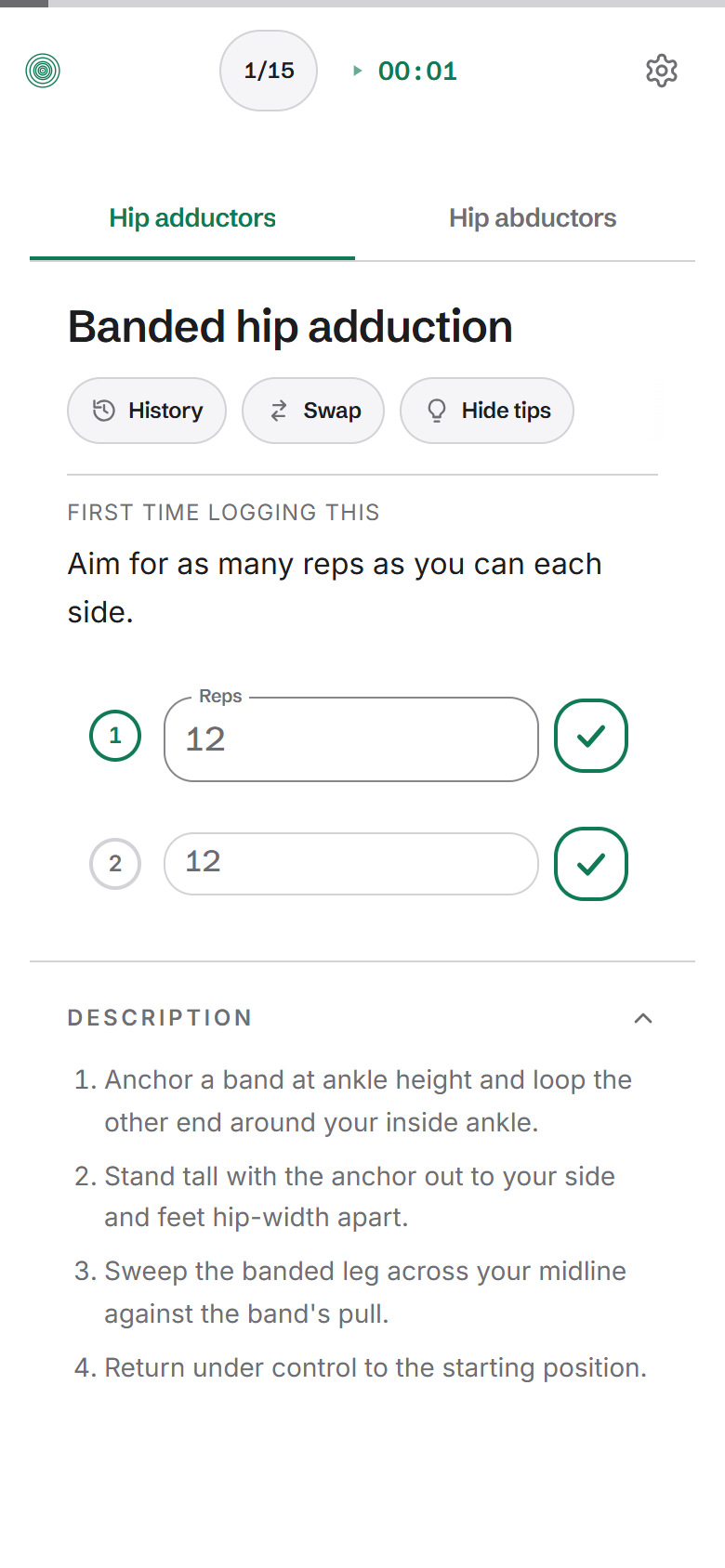
Two antagonist exercises per workout slot.
- 02
Rate.
After each exercise, tap "beat / exactly / missed".
- 03
Auto-adjust.
The next session's weight adapts automatically.
- 04
Done.
Full-body coverage in 19 pairs, about 30 minutes.
Why antagonist pairs
Opposing pairs. Complete body. Less time.
- EfficiencyRest for one muscle while the other works. Two exercises fit into the time one normally takes.
- BalanceTraining opposing muscles in the same slot keeps posture, joint health, and strength ratios in line.
- Neural recoveryActivating the antagonist inhibits fatigue in the primary mover. You perform better, set after set.
From the insights
Writing on training, not branding.
A complete workout in 30 minutes: what it actually takes
A 30-minute session can be complete if you drop the junk volume, pair antagonists, and let RPE pick your weights. Here's the math.
ReadKnee pain when squatting? Start at the ankles.
Knee pain during squats is often a dorsiflexion problem in disguise. Here's how ankle mobility dictates where load goes at the bottom of a squat, and how to fix it.
ReadHow many sets per muscle per week? An honest answer from the evidence
The research gives a range, not a single number. Here's what Schoenfeld, Helms, and Israetel actually say, and the minimum that moves the needle.
ReadStop program-hopping.
Start a complete program today. Rate each set, let the weights adjust themselves, and come back in 30 minutes.